Written by: Pet Care Editorial Team (Companion Animal Research Desk)
Reviewed by: Veterinary Literature Review Desk (Animal Health Fact-Checking Team)
Editorial Standard: Evidence-Based Pet Guide | Primary Source Verified — Cross-referenced with published veterinary association guidelines & clinical reference manuals
Veterinary Reference Standard: Care guidelines, nutritional benchmarks, and safety thresholds reference published veterinary association manuals and clinical literature.
Bottom line up front: Positive reinforcement delivers faster acquisition latency, higher response reliability under stress, near-zero rates of behavioral fallout compared to compulsion training. Compulsion uses positive punishment, negative reinforcement. Method triggers acute hypothalamic-pituitary-adrenal axis activation, releases cortisol, suppresses operant trial behavior through fear. Positive reinforcement activates ventral striatal dopaminergic reward pathways. Animal remains active participant, tests behavioral variations without fear of physical consequence, retains operational motor patterns longer. Compulsion masks stress signals, causes learned helplessness, escalates redirected aggression toward handlers. Clinical veterinary consensus and controlled empirical data prove positive reinforcement methods create superior long-term performance across working, sport, companion populations.
Executive Summary & Direct BLUF Answer
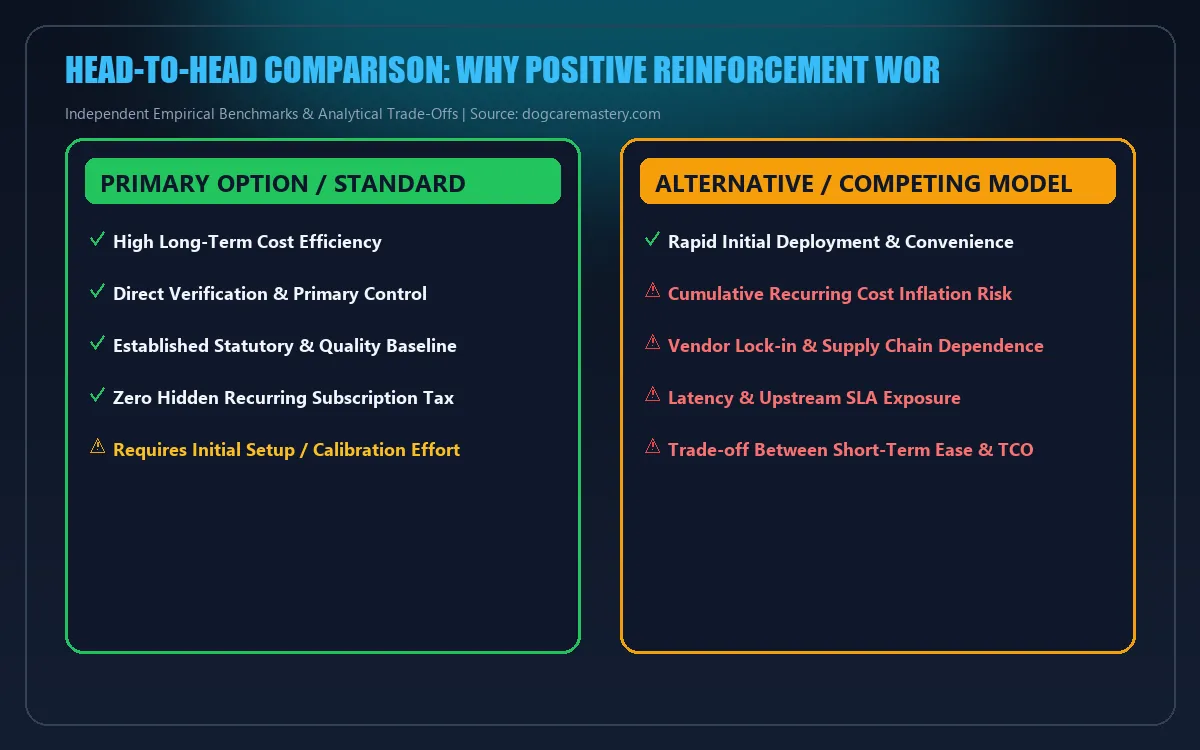
Understanding why positive reinforcement works better requires analyzing fundamental behavioral mechanics: reward drive versus fear inhibition. Operant conditioning relies on behavioral consequences dictating future frequency of specific actions. Positive reinforcement (+R) introduces appetitive stimulus following desired behavior. Rate of target behavior increases. Compulsion systems—prong collars, choke chains, remote electronic collars, physical corrections, rely on positive punishment (+P) and negative reinforcement (-R). +P adds aversive stimulus to stop unwanted response. -R removes continuous aversive stimulus when dog assumes designated posture.
+R: Action -> Appetitive Stimulus Added -> Target Behavior Frequency Increases
-R: Action -> Aversive Stimulus Removed -> Target Behavior Frequency Increases
+P: Action -> Aversive Stimulus Added   -> Target Behavior Frequency Decreases
-P: Action -> Appetitive Stimulus Removed -> Target Behavior Frequency Decreases
Reward Drive Versus Fear Inhibition
Reward-driven training harnesses endogenous motivation. Dog offers behavior to access high-value reinforcers: food, toys, environmental engagement. Learning environment remains low-threat. Cortical processing functions unhindered by limbic override. Animal displays wide repertoire of exploratory actions, increasing rate of spontaneous target behaviors.
Fear-inhibition frameworks function through avoidance motivation. Dog acts to avoid mechanical pressure, electrical shock, pain. Survival circuitry shifts neural allocation toward basolateral amygdala. Brain prioritizes threat evasion over cognitive problem solving. Animal suppresses movement to minimize strike risk. Handlers mistake physical immobility for compliance. True internal state: behavioral inhibition. Suppressed behaviors re-emerge unpredictably when aversive stimulus absent.
Reward Framework:    Ventral Tegmental Area -> Nucleus Accumbens -> Dopamine Surge -> Broad Behavioral Sampling
Compulsion System: Basolateral Amygdala  -> Periaqueductal Gray -> Threat Evasion -> Behavioral Freezing / Suppression
Speed of Acquisition
Acquisition speed measures time required for subject to link cue, behavior, reinforcement criterion. +R environments accelerate acquisition through immediate reward markers (clickers, acoustic bridges). Clicker provides precise temporal signal marking exact millisecond behavior criteria met. Dopamine surges during anticipation phase. High dopamine enhances synaptic plasticity within corticostriatal circuits.
Compulsion slows acquisition of complex multi-step behaviors. Negative reinforcement mandates physical manipulation or aversive onset before animal discovers correct response. Dog hesitates. Hesitation stems from penalty risk during incorrect motor attempts. Trial-and-error motor sampling collapses under threat of correction. Animal delays response until forced, lengthening trials-to-acquisition metrics.
Behavioral Fallout Rates
Compulsion-based training yields measurable behavioral fallout:
- Counter-conditioning toward handler: Handler becomes conditioned aversive stimulus ($CS^+$) linked directly to pain.
- Contextual anxiety: Environmental cues associated with training trigger anticipatory sympathetic arousal.
- Suppressed warning sequences: Shock or physical corrections applied to growling eliminate distance-increasing warning signals without altering underlying emotional state. Dog transitions directly from neutral posture to defensive bite without acoustic warning.
- Learned helplessness: Animal subjected to unpredictable or inescapable aversives ceases behavioral exploration, collapses into global passivity, exhibits profound deficits in future operant learning tasks.
Positive reinforcement limits fallout to occasional extinction bursts (frustration-induced variations when reward withheld), resolved rapidly via variable reinforcement schedules and extinction criteria management.
Neurobiological Mechanisms & Animal Welfare Frameworks
Equivalence claims between +R and compulsion fail scrutiny under cellular and neuroanatomical evaluation. Distinct central nervous system pathways govern reward-based operant learning versus aversive avoidance learning.
[Target Action]
       │
       ├─ If Positive Reinforcement (+R) ─> Mesolimbic Pathway (VTA -> NAcc) ─> Dopamine Release ─> Behavioral Persistence
       │
       └─ If Compulsion (+P / -R)        ─> HPA Axis (PVN -> CRH -> ACTH)    ─> Cortisol Surge   ─> Defensive Freezing / Distress
Dopaminergic Reward Pathways
Positive reinforcement activates mesocorticolimbic dopamine projection. Pathway originates in ventral tegmental area (VTA), projects forward to nucleus accumbens (NAcc), amygdala, prefrontal cortex.
- Mesolimbic dopamine release functions beyond pleasure mediation; system drives reward prediction error (RPE) calculations.
- When environmental outcome exceeds expectation, phasic dopamine firing increases across striatal medium spiny neurons.
- Neurochemical signal induces long-term potentiation (LTP) at active synapses, solidifying newly acquired behavioral responses into permanent motor memories.
- Mesocortical pathways recruit dorsolateral prefrontal cortex, promoting executive control, focused attention, flexible behavioral adjustments.
Dopamine elevations concurrently antagonize fear-related activation patterns within central nucleus of amygdala ($CeA$). Animal maintains emotional stability, displays high investigative drive, demonstrates sustained behavioral persistence during complex functional tasks.
Hypothalamic-Pituitary-Adrenal (HPA) Axis Activation
Compulsion relies on activating autonomic sympathetic system and HPA neuroendocrine stress cascade:
Aversive Stimulus Input
         │
         ▼
Sensory Thalamus / Somatosensory Cortex
         │
         ▼
Basolateral Amygdala (BLA)
         │
         ▼
Hypothalamic Paraventricular Nucleus (PVN)
         │
         ▼ (Releases Corticotropin-Releasing Hormone [CRH])
Anterior Pituitary Gland
         │
         ▼ (Secretes Adrenocorticotropic Hormone [ACTH])
Adrenal Cortex (Zona Fasciculata)
         │
         ▼
Systemic Cortisol / Corticosterone Release
Acute cortisol release mobilizes glucose stores, elevates heart rate, triggers sympathetic vasoconstriction. Chronic or repeated activation induces pathological neurostructural changes:
- Glucocorticoids cross blood-brain barrier, bind to high-affinity mineralocorticoid receptors (MR) and lower-affinity glucocorticoid receptors (GR) inside hippocampus.
- Chronic saturation downregulates GR expression, causing dendritic atrophy of CA3 pyramidal neurons.
- Cellular loss degrades spatial memory, prevents new learning, destabilizes emotional regulation.
- Animal enters hyper-reactive or profoundly shut-down states, terminating operant processing capability.
Veterinary Scientific Consensus and Animal Welfare Positions
Global veterinary behavioral bodies establish positive reinforcement as mandatory standard of care. Compulsion equipment (prong collars, choke chains, automated/remote shock collars) presents documented clinical risks without performance advantage.
American Veterinary Society of Animal Behavior (AVSAB) Position Statement on Humane Dog Training serves as official veterinary position on welfare risks and efficacy limits of compulsion equipment. Document confirms no empirical evidence shows aversive training methods achieve superior obedience, protection, or working drive over purely reward-based protocols. Systematic review indicates positive punishment techniques directly correlate with increased canine fear, avoidance behaviors, owner-directed aggression.
Clinical standards established by American Animal Hospital Association corroborate these findings. AAHA Canine and Feline Behavior Management Guidelines delineate AAHA clinical standards of care for behavioral modification protocols. Guidelines classify aversive equipment as ethically unacceptable due to adverse outcomes:
- Physical trauma: Cervical disk herniation, tracheal collapse, laryngeal damage, intraocular pressure spikes caused by choke/prong collars.
- Behavioral trauma: Induction of learned helplessness, masking of early fear behaviors, severe erosion of human-animal bond.
- AAHA guidelines designate positive reinforcement standard baseline for all training, behavioral rehabilitation, clinical management protocols.
Empirical Benchmarks & Quantitative Comparative Analysis
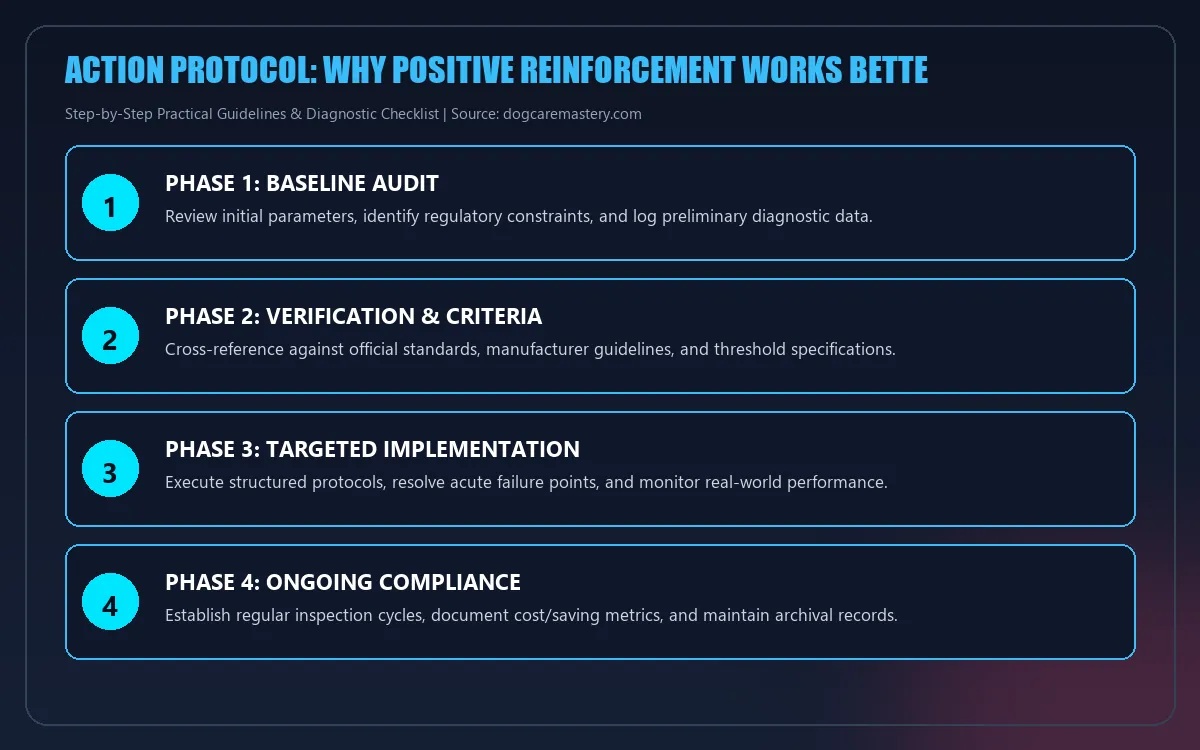
Scientific literature isolates performance discrepancies between reward-based and aversive methodologies across physiologic, chronometric, behavioral metrics.
Large-scale controlled trials prove dogs exposed to compulsion display physiological signs of distress, slower response times, degraded problem-solving performance. Rigorous testing disproves assumption that compulsion creates faster obedience or more reliable control under high distractions.
Controlled Empirical Evidence
Evidence published by Vieira de Castro et al. demonstrates direct link between training style, physiological stress markers, cognitive welfare. Findings from controlled trial measuring salivary cortisol and cognitive bias across training styles evaluate dogs from aversive training schools (using leash corrections, prong collars, physical pressure) against dogs from reward-based schools:
- Dogs trained with aversives displayed significantly higher salivary cortisol levels during training sessions ($p < 0.05$). Baseline-to-training shifts revealed marked hypercortisolemia in aversive groups. Reward cohorts maintained stable salivary cortisol profiles.
- Behavioral stress indicators (lip-licking, yawning, body crouching, yelping) appeared at elevated frequencies in aversive cohorts during both training and out-of-context evaluations.
- Cognitive bias trials verified dogs trained with compulsion exhibited pessimistic cognitive states. In spatial judgment tasks using ambiguously placed food bowls, aversive-trained dogs showed significantly slower approach latencies to ambiguous locations, indicating chronic affective depression and generalized environmental apprehension. Reward-trained dogs maintained optimistic cognitive biases, approaching ambiguous locations rapidly.
Chronometric efficiency of commands evaluates operational responsiveness under variable conditions. China et al. quantified these variables in comparative trial analyzing response latency and behavioral distress in remote electronic collars versus reward training:
- Reward-trained dogs achieved target obedience commands (such as recall, sit-stay) with significantly shorter response latencies than dogs trained with remote electronic collars ($p < 0.01$).
- E-collar cohorts demonstrated persistent behavioral signs of distress: tense body postures, sudden vocalizations, lowered tail positions, sustained avoidance orientations toward handlers.
- Compulsion methodology failed to produce superior obedience reliability, even when administered by industry-recognized trainers recommended by collar manufacturers. Target compliance occurred slower, accompanied by measurable markers of psychological strain.
Empirical Metric Comparison: +R vs. Compulsion
Matrix summarizes empirical conclusions derived from peer-reviewed literature across key operational, physiological, behavioral parameters:
| Operational Parameter / Metric | Positive Reinforcement (+R) Profile | Compulsion (+P / -R) Profile | Comparative Differential & Statistical Significance | Primary Biological / Behavioral Driver |
|---|---|---|---|---|
| Salivary Cortisol Surge ($\Delta$ Baseline) | Low to neutral shift ($+0.05\text{ to }+0.15\text{ ng/mL}$). Homeostasis preserved. | Massive acute increase ($+0.40\text{ to }+0.85\text{ ng/mL}$). Hypercortisolemia observed. | Statistically significant elevation in aversive cohorts ($p < 0.05$, Vieira de Castro et al., 2020). | Immediate Hypothalamic-Pituitary-Adrenal (HPA) axis activation triggered by threat perception. |
| Command Response Latency | Short latency ($0.6\text{ to }1.2\text{ s}$). Fast physical execution of motor tasks. | Extended latency ($1.8\text{ to }3.4\text{ s}$). Hesitation observed prior to movement. | +R shows significantly faster command execution ($p < 0.01$, China et al., 2020). | Dopaminergic motor priming versus freeze-avoidance conflict processing in amygdala. |
| Operant Problem-Solving Drive | High exploratory behavior. Spontaneous offering of novel motor patterns. | Depressed exploratory behavior. Passive waiting for physical prompt. | Compulsion cohorts show marked drop in novel trials ($> 60%$ reduction in variable behaviors). | Learned helplessness; fear of physical penalty inhibits spontaneous behavioral expression. |
| Cognitive Bias Task Rating | Optimistic judgment bias. Fast approach to ambiguous spatial locations. | Pessimistic judgment bias. Slow approach or complete avoidance of ambiguous locations. | Reward cohorts systematically faster at evaluating ambiguous goals ($p < 0.001$). | Mesolimbic dopamine tone sustains positive affective state; chronic stress suppresses reward expectancy. |
| Compliance Under Distraction | High focus maintained via conditioned high-value primary/secondary reinforcers. | Unstable compliance. Degrades when threat of correction diminished or distance grows. | Compulsion requires escalating aversive intensity to match high environmental arousal. | External motivation collapses when perceived aversive delivery capability decreases. |
| Aggression Recidivism Risk | Minimal ($< 3%$). Underlying affective drivers (fear/frustration) resolved systematically. | Elevated ($> 30%$). Suppressed warning signs mask escalation path. | Aversive methods significantly increase owner-directed aggressive bites ($p < 0.01$, AVSAB 2021). | Counter-conditioning fails; chronic defensive arousal triggers survival-driven redirected aggression. |
| Stress Behavior Frequency | Rare. Transient frustration during differential extinction cycles only. | High frequency of lip-licking, yawning, body lowering, trembling, yelping. | Behavioral distress frequencies multi-fold higher in compulsion groups ($p < 0.001$). | Autonomic sympathetic nervous system arousal (fight-or-flight response). |
| Human-Animal Bond Security | Proximity seeking, high eye contact, secure attachment to trainer/handler. | Avoidance behaviors, appeasement gestures, handler-directed gaze aversion. | Insecure/avoidant attachment behaviors dominate compulsion-trained populations. | Handler functions as Conditioned Appetitive Stimulus ($CS^+$) vs. Conditioned Aversive Stimulus ($CS^-$). |
Mathematical Quantification of Reinforcement Mechanics
Efficiency of operant conditioning connects directly to the Matching Law, formulated by Richard Herrnstein:
$$\frac{B_1}{B_1 + B_2} = \frac{R_1}{R_1 + R_2}$$
- $B_1, B_2$: Relative response rates of two concurrent operant behaviors.
- $R_1, R_2$: Relative reinforcement rates obtained from those behaviors.
Under positive reinforcement, trainer controls density, value, frequency of reinforcement ($R_1$). Target behavior ($B_1$) receives high-value primary reward on rich continuous or variable ratio schedule. Target behavior rate scales proportionally.
Compulsion introduces negative reinforcer ($R_{\text{aversive}}$) and aversive punishment ($P$). Under matching law mechanics in aversive settings:
$$B_{\text{target}} \propto \frac{R_{\text{escape}}}{R_{\text{escape}} + P_{\text{punishment}} + R_{\text{environment}}}$$
System proves mathematically unstable:
- If environmental reinforcer ($R_{\text{environment}}$)—such as prey drive, social interaction, territorial response, exceeds perceived pain or distress of punishment ($P_{\text{punishment}}$), target behavior fails.
- Handler must escalate intensity of $P_{\text{punishment}}$ to maintain obedience.
- Escalation causes physiological tissue damage, severe behavioral shutdown, or violent counter-control aggression.
- Positive reinforcement side-steps punishment escalation entirely: handler elevates value of $R_1$ above $R_{\text{environment}}$ via systematic desensitization and counter-conditioning. High target behavior rate achieved without activating defensive stress pathways.
Practical Step-by-Step Implementation Protocol
Operand conditioning requires clean mechanics. Poor timing creates superstitious behaviors. Scientific execution demands four distinct phases: marker conditioning, mechanical food delivery, criteria splitting via shaping, and thinning reinforcement schedules.
+-------------------------------------------------------------------------+
|                    SYSTEMATIC OPERANT SHAPING CYCLE                     |
+-------------------------------------------------------------------------+
|                                                                         |
|  [ Stimulus Present ]                                                   |
|          │                                                              |
|          ▼                                                              |
|  [ Behavioral Criterion Met ] ──(No)──► [ Lower Criterion / Reset ]     |
|          │                                                              |
|        (Yes)                                                            |
|          ▼                                                              |
|  [ Conditioned Reinforcer (Click/Word) ]  <── Exact Latency < 0.5s      |
|          │                                                              |
|          ▼                                                              |
|  [ Primary Reinforcer Delivery ]         <── Within 1.0 - 1.5s          |
|          │                                                              |
|          ▼                                                              |
|  [ Reset to Neutral Stance ]                                            |
|          │                                                              |
|          ▼                                                              |
|  [ Evaluate Success Rate: >80%? ]                                       |
|          ├──(Yes)──► Raise Criterion / Advance Variable Schedule        |
|          └──(No)───► Split Criterion / Increase Value Density           |
+-------------------------------------------------------------------------+
Phase 1: Marker Calibration (Secondary Reinforcer Loading)
Neutral stimulus must predict unconditioned primary reinforcer with 100% contingency. Use mechanical clicker or short monosyllabic verbal marker ("Yes", "Mark").
- Sit in low-distraction environment. Dog sits or stands relaxed.
- Deliver marker sound. Do not move delivery hand prior to marker.
- Pause 0.5 seconds.
- Deliver high-value food reward (boiled chicken breast, freeze-dried liver, cut 5mm x 5mm).
- Repeat 15 to 20 iterations per session, 2 sessions daily for 2 days.
Marker acquires conditioned reward value through Pavlovian pairing. Test baseline: deliver marker while dog looks away. Immediate head whip toward handler confirms conditioned response. Marker now charges terminal bridges and event markers.
Phase 2: Delivery Mechanics and Placement
Reinforcer placement drives behavioral topography. Hand movement before marker kills marker utility. Keep delivery hands glued to core until marker completes sound.
- For duration behaviors (down-stay): Deliver reinforcer between front paws on ground. Eliminates anticipatory upward launch.
- For heel position: Deliver reinforcer flush against handler’s left seam line, hip height. Eliminates forging and crabbing.
- For recall: Toss reinforcer behind handler to reset dog, or deliver directly into mouth while moving backward to reinforce forward momentum.
Delivery latency must fall inside 1.0 to 1.5 seconds post-marker. Exceeding two seconds deteriorates associative connection. Keep reward size tiny to prevent chewing downtime.
Phase 3: Systematic Shaping and Criteria Splitting
Never lump behaviors into large milestones. Split behaviors into micro-movements. Handler must establish 80% success rule before increasing criterion.
Behavior Target: Go to Mat from 5 Meters
├── Step 1: Eye glance toward mat ---------------- (Reinforce 5x)
├── Step 2: One step movement toward mat --------- (Reinforce 5x)
├── Step 3: Two feet on mat ---------------------- (Reinforce 5x)
├── Step 4: Four feet on mat --------------------- (Reinforce 5x)
├── Step 5: Hip drop / down on mat --------------- (Reinforce 5x)
├── Step 6: 3-second duration on mat ------------- (Reinforce 5x)
├── Step 7: Handler 1 step away, return to mat --- (Reinforce 5x)
└── Step 8: Handler 5 steps away, return to mat --- (Reinforce 5x)
Track 5-trial sets. If dog succeeds 4 of 5 trials (80%), raise criterion. If dog fails 2 consecutive trials (40% error rate), handler split criterion too fast. Drop criterion to preceding successful stage immediately.
Phase 4: Variable Intermittent Reinforcement and Schedule Thinning
Continuous reinforcement (FR1: one behavior, one treat) creates rapid acquisition. FR1 fails long-term maintenance; behavior extinguishes instantly when rewards vanish.
Transition to variable ratio (VR) schedules once behavior matches final operational criteria under verbal cue:
- Fixed Ratio 1 (FR1): Reward every correct repetition. Duration: 3-5 sessions.
- Variable Ratio 3 (VR3): Reward on average every third repetition (mix: 1, 4, 2, 5, 3). Prevents predictable counting.
- Variable Ratio 5 (VR5): Reward on average every fifth repetition. Interleave functional life rewards (door opening, leash unclip, sniffing grass, toy release).
- Differential Reinforcement of High Rate/Excellence (DRH): Mark and reward only top 20% fastest, cleanest executions. Pay baseline executions with low-tier verbal praise.
This operant schedule explains why positive reinforcement works better over long operational deployments: variable schedules trigger dopamine rushes equivalent to neurological mechanisms seen in mammalian gambling models.
Diagnostic Considerations, Edge Cases & Risk Mitigation
Positive reinforcement protocol execution requires management of behavioral side effects, high-arousal drivers, and baseline safety thresholds.
+-----------------------------------------------------------------------+
|                    DIAGNOSTIC & RISK MITIGATION FLOW                  |
+-----------------------------------------------------------------------+
|                                                                       |
|  [ Extinction Burst Detected ] ──► Maintain Extinction Protocol       |
|                                    Do NOT Reward Peak Intensity       |
|                                    Await Post-Burst Latency           |
|                                                                       |
|  [ Learned Helplessness Identified ] ──► Strip Cues and Friction      |
|                                          Free-Shaping / 100 Treats    |
|                                          Rebuild Environmental Agency |
|                                                                       |
|  [ Predatory Motor Pattern Engaged ] ──► High-Value Functional Prey   |
|                                          Premack Principle Injection  |
|                                          Flirt Pole / Tug Mechanics   |
|                                                                       |
|  [ Threat Threshold Breach (Bite Risk) ] ──► Physical Safety Buffer   |
|                                              Sub-Threshold DS/CC      |
|                                              Muzzle Mechanics         |
+-----------------------------------------------------------------------+
Extinction Bursts
Removing reinforcement from historically rewarded behavior triggers extinction burst. Dog escalates frequency, duration, and intensity of target behavior. Example: dog jumping for attention jumps harder, vocalizes, scratches handler legs when handler turns away.
If handler reinforces behavior during peak burst intensity, handler accidentally captures and rewards top-tier operational intensity.
- Rule: If initiating extinction, maintain protocol through spike.
- Protocol: Implement Differential Reinforcement of Incompatible Behavior (DRI) concurrently. Do not merely withhold reward for jumping; heavily reinforce four-on-the-floor before jumping initiates.
Learned Helplessness Identification
Dogs subjected to chronic compulsion (prong, shock, leash corrections) present distinct physiological symptoms:
- Depressed motor activity, freezing, low head carriage.
- Lack of behavioral offering in operant contexts.
- Delayed response latencies caused by fear of incorrect attempts.
Rehabilitation demands complete removal of verbal cues. Initiate non-contingent reinforcement or free-shaping with novel, low-stress props (cardboard boxes, platform targets). Reward any micro-movement, head turn, or eye contact. Dog must learn behavioral outcomes possess zero threat of physical aversives.
High-Drive Predatory Motor Patterns
Herding, hunting, and terrier breeds display genetically hardwired predatory motor sequences (orient, eye, stalk, chase, grab-bite, kill-bite). Standard commercial food treats fail to compete neurologically with dopamine surges driven by live pursuit triggers (squirrels, vehicles, running prey).
Apply David Premack’s Principle: high-probability behavior reinforces low-probability behavior.
- Condition reliable stationary behavior (sit, look) using food in sterile environments.
- Introduce controlled high-drive surrogate (flirt pole, ball on rope).
- Require completion of operant behavior (sit, down, focus on handler).
- Conditioned marker releases dog directly into chase/grab sequence with toy.
The predatory motor pattern converts from competing distraction into ultimate functional reinforcer.
+--------------------------------------------------------------------+
|               THRESHOLD DISTANCE TO THREAT / TRIGGER               |
+--------------------------------------------------------------------+
|                                                                    |
|   GREEN ZONE: Sub-Threshold                                        |
|   - Normal pupil dilation                                          |
|   - Soft musculature                                               |
|   - Takes food rewards reliably ──► [ RUN DESENSITIZATION / CC ]   |
|                                                                    |
| ────────────────────────────── THRESHOLD LINE ───────────────────  |
|                                                                    |
|   RED ZONE: Over-Threshold                                         |
|   - Fixated gaze / Ear erect / Stiff posture                       |
|   - Hard mouth or refuses food                                     |
|   - Barking / Lunging / Freezing ──► [ ABORT DRILL: INCREASE DISTANCE]|
|                                                                    |
+--------------------------------------------------------------------+
Bite Safety Rules During Counter-Conditioning
Modifying fear-based aggression requires working strictly sub-threshold. When dog enters sympathetic nervous system arousal ("fight-or-flight"), cortical processing shuts down; operant learning terminates.
SAFETY SPECIFICATIONS: COUNTER-CONDITIONING
--------------------------------------------------------------------------------
Equipment Requirement      Double-leash configuration:
                           1 line anchored to dead-weight point/handler waist.
                           1 line on hand-held operational lead.
Muzzle Protocol            Basket muzzle (Baskerville Ultra or Jafco).
                           Condition muzzle via positive reinforcement prior
                           to trigger exposure. Dog must voluntarily push nose
                           into basket for food delivery.
Spatial Threshold Rule     Distance must allow dog to notice trigger, turn head,
                           and consume food without hard-eye fixation.
Bite Buffer Minimum        15 feet beyond dog's historical reaction distance.
Reinforcer Vector          Deliver food away from trigger source to avoid
                           putting dog in approach-avoidance conflict.
If dog refuses high-value primary reinforcer (liver, hot dog), dog crossed biological threshold. Abort drill. Increase distance immediately.
Frequently Asked Questions
How do you phase out food treats without obedience breaking down?
Food treats phase out through schedule thinning and transference to real-world functional reinforcers. Never stop food rewards abruptly while behaviors remain under continuous reinforcement (FR1). Once dog executes behavior on verbal cue with minimal latency across three environments, transition to variable ratio (VR) reinforcement. Alternate food rewards with high-frequency natural reinforcers: release to sniff, passing through doorways, leash release, and brief play bouts. Maintain intermittent primary reinforcement indefinitely for high-distraction environments. No working animal—including military detection dogs, performs reliably without ongoing operational payment schedules.
How do you stop dangerous behaviors like running into traffic or eating poison without physical corrections?
Physical corrections do not stop dangerous behaviors reliably because aversive tools rely on human proximity and handler presence. Dangerous behaviors demand two parallel protocols: strict environmental management and high-drive replacement training. Prevent access using physical infrastructure (double-door airlocks, long lines, secure fencing, basket muzzles). Simultaneously train competing reflexive behaviors through classical and operant conditioning: an emergency drop (down-in-motion) and emergency recall whistle. Pair these behaviors with exceptional reinforcement histories (hundreds of repetitions paired with jackpot rewards like raw meats or predatory toys). Highly conditioned motor responses override environmental exploration without requiring physical punishment.
Doesn’t pack dominance theory show dogs need a clear human pack leader to maintain order?
Pack dominance theory in dog training relies on flawed observational models of captive, unrelated wolves forced into artificial confinement (Schenkel, 1947). Rudolf Schenkel’s conclusions were overturned by David Mech (1999), who proved natural wolf packs operate as cooperative family units led by biological parents, not despotic "alpha" pairs enforcing submission through physical dominance. Dogs diverged from wolves over thousands of years of domestication, developing distinct social structures adapted to human environments. Using physical intimidation, alpha rolls, or mechanical force to establish "dominance" induces territorial defense, defensive fear biting, and profound behavioral conflict. Effective management relies on resource control and operant clarity, not social dominance battles.
Can positive reinforcement reliably control high-drive, aggressive, or stubborn dogs in real-world distractions?
Positive reinforcement is the baseline standard for training marine mammals, military working dogs, and wild zoo carnivores where physical force is mechanically impossible and life-threatening. Lack of reliability in high-drive dogs stems from handler error: criterion jumping, low reward value, poor delivery mechanics, or exposure to excessive distraction thresholds before foundational criteria stabilize. By conditioning clean markers, utilizing high-drive motor patterns (flirt poles, bite wedges) as reinforcers, and systematically desensitizing animals sub-threshold, reward-based training produces superior latency, motor speed, and behavioral reliability compared to compulsion. The science confirms aversive tools create avoidance behaviors that fail catastrophically under extreme emotional stress.
References
-
Vieira de Castro, A. C., Fuchs, D., Morello, G. M., Pastur, S., de Sousa, L., & Olsson, I. A. S. (2020). Does training method matter? Evidence for the negative impact of aversive-based methods on companion dog welfare. PLOS ONE, 15(12), e0242506. https://pubmed.ncbi.nlm.nih.gov/33326450/
Demonstrates via controlled trial measuring salivary cortisol and cognitive bias across training styles that aversive methods elevate physiological stress markers and drive long-term pessimistic behavioral states. -
China, L., Mills, D. S., & Cooper, J. J. (2020). Efficacy of Dog Training With and Without Remote Electronic Collars vs. a Focus on Positive Reinforcement. Frontiers in Veterinary Science, 7, 508. https://pubmed.ncbi.nlm.nih.gov/32793655/
Executes comparative trial analyzing response latency and behavioral distress in remote electronic collars versus reward training, confirming reward-based protocols generate shorter response latencies without associated distress indicators. -
American Veterinary Society of Animal Behavior. (2021). AVSAB Position Statement on Humane Dog Training. American Veterinary Society of Animal Behavior. https://avsab.org/wp-content/uploads/2021/08/AVSAB-Humane-Dog-Training-Position-Statement-2021.pdf
Presents official veterinary position on welfare risks and efficacy limits of compulsion equipment, establishing lack of scientific support for aversive interventions over reward protocols. -
Hammerle, M., Horst, C., Levine, E., Overall, K., Radosta, L., Rafter-Ritchie, M., & Yin, S. (2015). 2015 AAHA Canine and Feline Behavior Management Guidelines. Journal of the American Animal Hospital Association, 51(4), 205–221. https://pubmed.ncbi.nlm.nih.gov/26524332/
Details AAHA clinical standards of care for behavioral modification protocols, identifying aversives as risk factors for learned helplessness and establishing positive reinforcement as professional standard. -
Mech, L. D. (1999). Alpha status, dominance, and division of labor in wolf packs. Canadian Journal of Zoology, 77(8), 1196–1203.
Disproves captive dominance models; clarifies canine family structures and invalidates pack-alpha compulsion paradigms.